

Parent Categories



Related Products


Related Books
Beyond the Windmills: The Many Meanings of Miguel de Cervantes’ Don Quixote
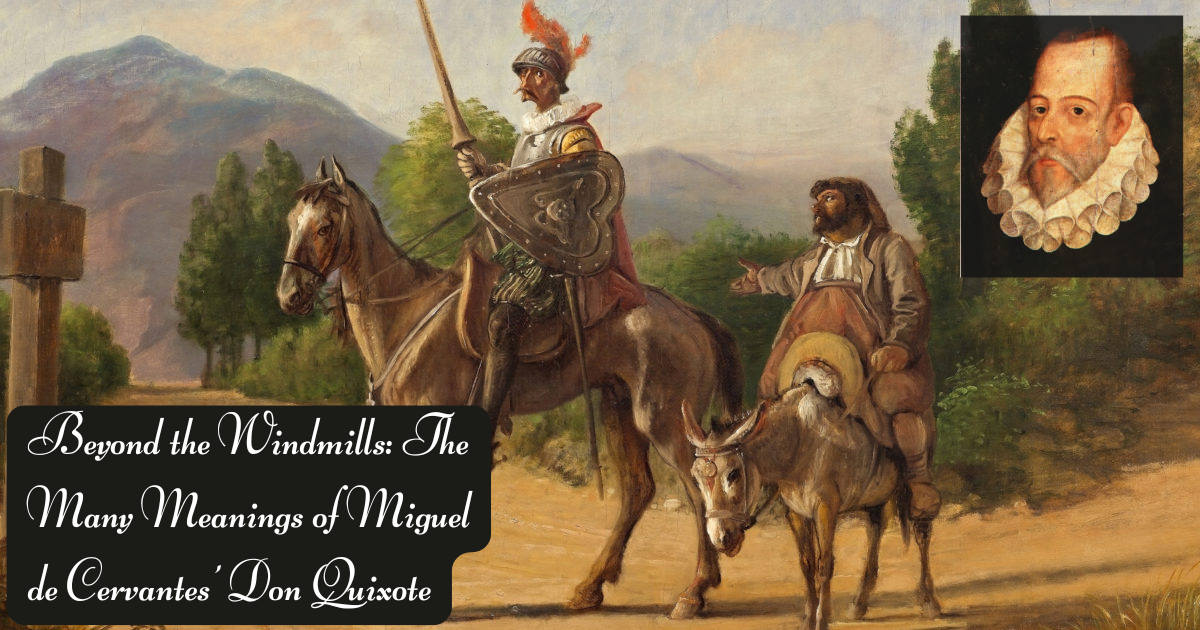 Don Quixote
Few scenes in literature are as instantly recognisable as Don Quixote charging towards a group of windmills, convinced that they are ferocious giants. His companion, Sancho Panza, tries to tell him otherwise, but Quixote is already committed to his vision. He lowers his lance, spurs his horse and rides forward.
The windmills become giants. The lance breaks. The knight falls.
It is funny, absurd and strangely moving—and it is also one of the most misunderstood moments in literature. Don Quixote is often reduced to the image of a foolish old man fighting imaginary enemies. Yet Miguel de Cervantes’ great novel, first published in two parts in 1605 and 1615, is doing something far more complicated. It is a novel about imagination, reality, storytelling, idealism, friendship, identity and the strange human need to believe that life can mean more than it appears to.
Also read: Why Are We Still Reading Lord of the Flies? William Golding and the Darkness Within Human Nature
A Man Who Reads Too Much
 [Image credit: www.conniejjasperson.com]
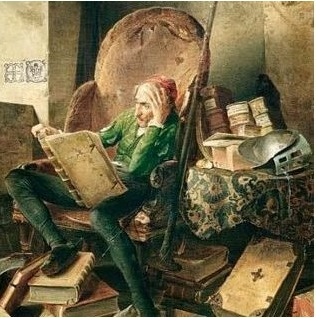
At the centre of the novel is Alonso Quixano, a country gentleman who spends so much time reading books about knights and chivalry that the boundaries between fiction and reality begin to collapse. He decides to become a knight himself. He renames himself Don Quixote, gives his old horse the grand name Rocinante and chooses a peasant woman, Aldonza Lorenzo, as his imaginary lady, calling her Dulcinea del Toboso.
To modern readers, his transformation can seem ridiculous. But Cervantes is not simply laughing at someone who has read too many books. He is asking a more uncomfortable question: What happens when the stories we consume begin to shape the way we understand the world?
Quixote sees everything through the language of chivalric romance. Inns become castles. Prostitutes become noble ladies. Ordinary villagers become characters in an epic adventure. His imagination constantly rewrites reality.
And yet, there is something strangely admirable about him. He refuses to accept a dull world simply because everyone else does.
The Windmills Are More Than Windmills
 [Image credit: www.franksmits.substack.com]
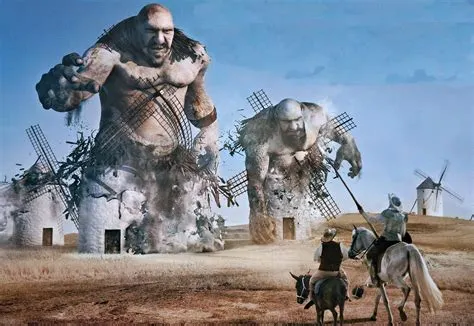
The famous windmill episode works because it can be read in several ways at once.
On the simplest level, it is comic: Quixote is mistaken, and Sancho knows the truth. But the scene also exposes the novel's central tension between what is and what ought to be.
The windmills are objectively windmills. But Quixote sees giants because he believes the world should contain giants worthy of a knight's courage.
That does not make him correct. His imagination repeatedly causes trouble, pain and humiliation. Yet Cervantes refuses to make the distinction between reality and illusion entirely comfortable. Quixote may misunderstand the world, but the supposedly sensible characters around him are hardly presented as perfectly rational either.
In fact, sometimes Quixote's madness allows him to see truths that ordinary people ignore.
Sancho Panza and the Wisdom of the Ordinary
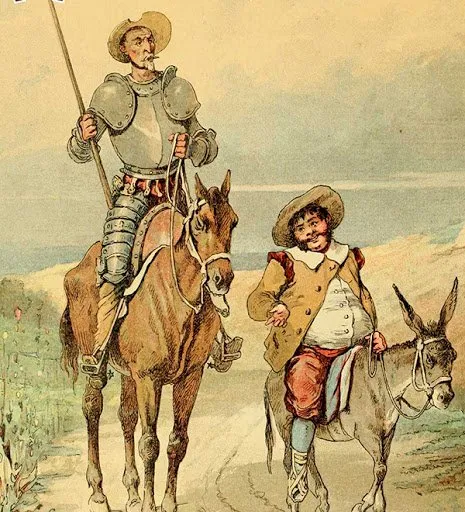 [Image credit: www.god-buddies.com]
If Quixote represents imagination, Sancho Panza often seems to represent common sense. Where Don Quixote is an idealistic, delusional knight, Sancho Panza is his practical, down-to-earth squire, representing everyday reality. He knows that windmills are windmills. He is concerned with food, money, sleep and practical survival. He rides a donkey while his master rides Rocinante, and the contrast between the two is one of the novel's great sources of humour.
But Sancho is not merely the sensible sidekick.
As the novel progresses, the two men begin to influence one another. Sancho becomes more imaginative, while Quixote occasionally becomes more grounded. Their relationship gradually becomes a portrait of friendship: two people with profoundly different ways of seeing the world who nevertheless learn to inhabit the same one.
This is one of the reasons Don Quixote remains so emotionally resonant. Behind the jokes is a story about companionship.
The Birth of the Modern Novel
Don Quixote is also remarkable because it constantly questions the nature of storytelling itself.
Cervantes plays with authorship, unreliable narrators, fictional manuscripts and characters who become aware of stories about themselves. In the second part, published a decade after the first, Don Quixote and Sancho are already famous within the fictional world because the first part of their adventures has supposedly been published.
The effect is wonderfully strange. The characters are living inside a story that they know has become a story.
This self-awareness makes Don Quixote feel surprisingly modern. Long before postmodern fiction began playing with narrative and authorship, Cervantes was asking readers to think about who tells a story, whose version of events becomes “truth” and how fiction changes the people who encounter it.
Madness, or Another Kind of Freedom?
The novel's treatment of madness is equally complex.
Quixote is clearly detached from reality in important ways, and the people around him repeatedly attempt to cure, deceive or restrain him. Yet his madness gives him a peculiar freedom. He can challenge social conventions because he does not see them as fixed.
He refuses to accept that a poor girl cannot be a princess in the realm of imagination. He believes that courage matters more than status. He insists on acting according to ideals in a world that frequently rewards selfishness and deception.
That does not make his ideals practical. But Cervantes leaves us wondering whether practicality alone is enough.
Perhaps the tragedy of Quixote is not simply that he mistakes fantasy for reality. Perhaps it is that reality is sometimes too small for the ideals by which human beings want to live.
The Comedy Beneath the Melancholy
For all its philosophical depth, Don Quixote remains extraordinarily funny. Cervantes constantly punctures grand declarations with mundane realities. Quixote can deliver an eloquent speech about honour one moment and be knocked off his horse the next.
This mixture of comedy and melancholy is part of the book's genius.
We laugh at Quixote because he is ridiculous. Then, almost without warning, we feel sorry for him. His dream of becoming a heroic knight may be impossible, but his desire to live meaningfully is deeply human.
That is why the windmills have endured as one of literature's most powerful images. They are not simply symbols of foolishness. They can represent impossible dreams, misplaced courage, stubborn idealism—or the human tendency to fight battles that exist partly because we believe in them.
More than four centuries after Cervantes created him, Don Quixote still rides across the plains of La Mancha. Sometimes he looks foolish. Sometimes he looks heroic. Sometimes he looks like all of us: trying to distinguish the world as it is from the world we desperately wish it could be.
And perhaps that is the greatest achievement of Don Quixote. It does not ask us simply to choose between reality and imagination. It asks us to consider what each one gives—and what each one takes away.
Your next read: From Devdas to Srikanta: Exploring Sarat Chandra Chattopadhyay’s Literary World